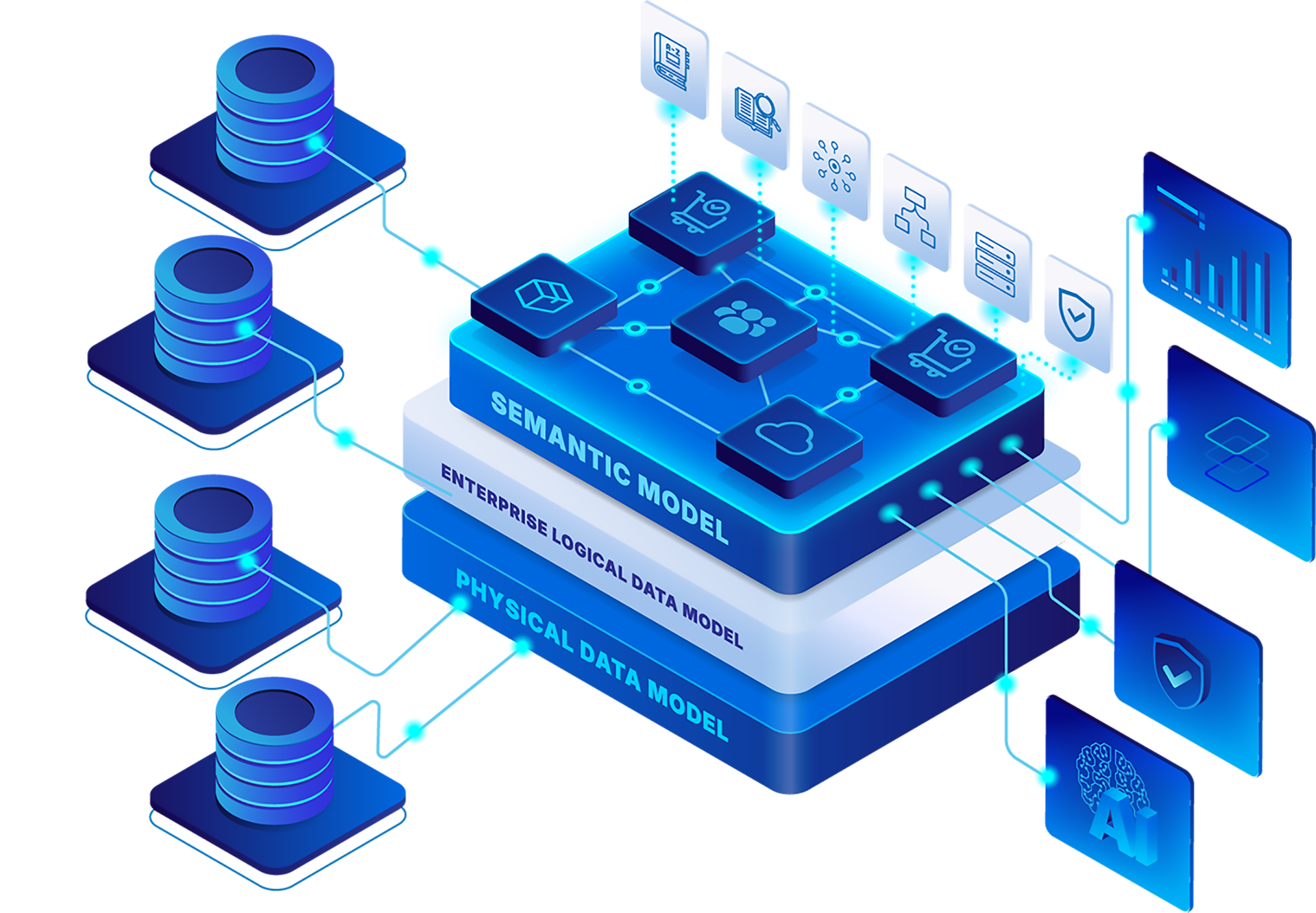
Different systems often define the same business concept in different ways. Finance may count a customer at the first invoice, while sales counts one at the signed contract. When both teams pull a report, the numbers do not match.
A governed semantic model helps prevent these inconsistencies by defining business concepts, their meaning, and their relationships independently of the systems where the underlying data is stored. It creates a shared semantic foundation that can be reused across data architecture, governance, analytics, and AI.
For organizations using ER/Studio, the Enterprise Logical Data Model (ELDM) provides this foundation. It captures business concepts, definitions, attributes, relationships, rules, and other context that explain what enterprise data means. That governed meaning can then be extended into semantic layers and other semantic assets used by downstream technologies.
A semantic model represents how an organization understands its data.
It defines business concepts such as Customer, Order, Product, Account, or Active Patient, what those concepts mean, the attributes that describe them, and how they relate to one another. Unlike a physical data model, this meaning is not tied to a particular database or implementation.
In ER/Studio, the Enterprise Logical Data Model serves as this governed semantic foundation. The ELDM captures business concepts and their relationships while business definitions, glossary terms, taxonomies, ontologies, domains, and other governance metadata provide additional meaning and context.
Together, these elements create a semantic backbone that can support multiple downstream systems without requiring each system to independently recreate the organization’s business meaning.
Terminology can vary significantly between technologies, however.
In Power BI, Microsoft uses “semantic model” for what it previously called a “dataset.” A Power BI semantic model contains the tables, relationships, measures, calculations, and other information used to support Power BI analytics.
Other BI and analytics vendors may use “semantic model” or “semantic layer” for a tool-specific modeling layer that defines metrics, dimensions, calculations, and relationships.
In an enterprise data architecture context, the semantic model can sit above these individual implementations. It establishes shared business meaning that downstream semantic layers can consume.
This distinction is important because an organization may use Power BI today, dbt for another analytics workflow, and different technologies in the future. The underlying definition of concepts such as Customer or Revenue should not have to change every time the technology changes.
Semantic, logical, and physical modeling are sometimes described as completely separate disciplines. In practice, an enterprise logical data model can also provide the semantic model for the organization.
The difference is primarily one of purpose and implementation.
| Artifact | Primary question | What it contains |
| Enterprise logical data model / semantic model | What does the business need to know, what does it mean, and how is it related? | Business concepts, entities, attributes, relationships, definitions, rules, domains, and other semantic context |
| Physical data model | How will this information be implemented on a particular technology? | Tables, columns, data types, constraints, indexes, and other platform-specific structures |
| Semantic layer | How should a particular analytics or technology platform consume and present that meaning? | Measures, dimensions, calculations, labels, relationships, metrics, and platform-specific semantic metadata |
This is why an ELDM can be much more than a database design artifact.
A physical model describes how data is implemented. The ELDM describes the business concepts the implementation represents. When definitions and governance metadata are connected to those concepts, the ELDM becomes a durable semantic model that can remain consistent even as physical databases and downstream tools change.
A semantic backbone is the authoritative representation of an organization’s important business concepts, relationships, definitions, and rules.
Consider a concept such as Customer.
A CRM may represent a customer one way. A data warehouse may store customer information differently. A Power BI model may contain another representation, while an AI application may access customer information from several sources simultaneously.
Those implementations can be different without the underlying business concept being different.
The semantic backbone establishes what Customer means, which attributes describe it, how it relates to concepts such as Account, Order, or Product, and which business rules apply.
Individual systems can then map their implementations back to that shared meaning.
Instead of redefining the business independently in every technology, organizations can define meaning once and reuse it across the data ecosystem.
The terms semantic model and semantic layer are frequently used interchangeably, but distinguishing them can be useful when designing an enterprise semantic architecture.
A semantic model establishes shared business meaning.
A semantic layer makes that meaning available within a particular analytics or technology environment.
For example, an enterprise semantic model may establish that Revenue has an approved definition and define how Customer, Order, Product, and Payment relate to one another.
A Power BI semantic layer can then implement the appropriate dimensions, measures, relationships, and calculations for Power BI. A dbt Semantic Layer can expose corresponding metrics for analytics engineering workflows.
Both can draw from the same governed enterprise meaning.
This approach reduces the need to recreate business logic independently within every downstream platform.
Without that shared foundation, one analytics team may calculate Revenue one way in Power BI while another implements it differently in dbt. Both implementations may be technically valid, but the organization is left with competing versions of the same business concept.
That is semantic drift.
Power BI creates an important terminology challenge because Microsoft now uses semantic model for the artifact previously called a dataset.
Within Power BI, that terminology is correct.
A Power BI semantic model contains the tables, relationships, measures, calculations, and other structures that support Power BI reports and analytics.
But a Power BI semantic model is still specific to Power BI. By itself, it does not establish how every other system in the enterprise must define Customer, Revenue, Product, or another business concept.
Two teams could create separate Power BI semantic models and implement the same business concept differently.
This is where an enterprise semantic backbone becomes valuable.
Instead of asking each report author or analytics team to recreate business meaning, organizations can establish that meaning within a governed Enterprise Logical Data Model and carry it into downstream environments.
ER/Studio’s Microsoft Power BI Semantic Layer Generator is designed around this approach. It uses governed physical star schemas and business metadata inherited from the ELDM to generate Power BI semantic layer artifacts, helping organizations carry established business meaning into Power BI rather than rebuilding it manually.
The same problem becomes increasingly important when data is used by AI.
An LLM can interpret words and patterns, but it does not inherently know how a particular organization defines Customer, Revenue, Active Patient, Policy Holder, or another business-specific concept.
The problem becomes even greater when multiple systems use different names or definitions for the same concept.
For example, imagine an AI assistant is asked:
“How many active customers did we have last quarter?”
One source system defines an active customer as anyone who made a purchase during the previous 12 months. Another defines one as an account with an active subscription. A third includes prospects with open contracts.
The AI system now has access to data, but it does not have an authoritative understanding of what active customer means.
Giving AI access to more data does not solve that problem.
The organization needs a semantic foundation that defines the concept, its relationships, and the rules that determine which interpretation is correct.
An Enterprise Logical Data Model can provide that context by explicitly representing business concepts and their relationships. Glossary definitions, taxonomies, ontologies, and governance metadata can enrich the model further.
That makes enterprise data more legible to AI and gives AI systems a governed semantic foundation from which to interpret business information.
An Enterprise Logical Data Model provides the architectural foundation, but semantic context can extend beyond entities and relationships.
Business glossaries, taxonomies, and ontologies add different forms of meaning.
A business glossary provides authoritative definitions for important business terms.
For example, instead of allowing individual departments to maintain separate definitions of Active Patient, the organization can establish an approved definition and connect it to the appropriate model objects.
This helps users understand not simply that an attribute exists, but what it means to the business.
A taxonomy organizes concepts into classifications and hierarchies.
For example:
Patient → Active Patient
The classification shows that Active Patient is a more specific concept within the broader category of Patient.
An ontology captures semantic relationships between concepts.
For example:
Customer places Order
Order contains Product
Patient receives Treatment
These relationships provide context that isolated glossary definitions cannot provide on their own.
The Enterprise Logical Data Model already captures many important relationships between business concepts. Ontologies can extend and formalize that semantic context for additional governance, knowledge graph, and AI use cases.
Together, the ELDM, glossary, taxonomy, ontology, and governance metadata create a richer representation of enterprise meaning.
A semantic model becomes significantly more useful when business meaning can be traced to its technical implementation.
Within ER/Studio, logical entities and attributes can be connected to the physical tables and columns that implement them across different platforms.
This creates a bridge between:
Business meaning → logical model → physical implementation
Suppose the governed semantic model defines Customer and establishes the attributes that describe a customer.
Those concepts may ultimately be implemented differently in SQL Server, Snowflake, Oracle, Databricks, or another platform. The physical structures can vary while remaining connected to the same logical business definition.
This allows teams to understand not only where data is stored, but what that data represents.
Existing databases can also be reverse engineered into ER/Studio, allowing teams to document current physical structures, connect them to logical models, and add the business context needed for governance and semantic architecture.
Establishing the semantic model is only part of the challenge. Organizations also need a way to carry that meaning into the technologies that consume their data.
Historically, this has involved substantial manual work.
Analytics teams recreate definitions inside BI tools. Data teams recreate them in transformation pipelines. Governance teams maintain another set of definitions in cataloging platforms. AI teams may then create yet another representation for knowledge graphs or retrieval systems.
Every manual recreation creates another opportunity for semantic drift.
ER/Studio provides a different approach.
The ER/Studio Semantic Generator transforms governed Enterprise Logical Data Models into reusable, machine-readable semantic assets. This allows the business meaning already captured in the model to be extended into downstream analytics, governance, knowledge graph, and AI environments.
Rather than defining meaning separately in every system, teams can start from the same governed semantic backbone.
Different technologies require semantic information in different formats. A single governed semantic foundation therefore needs multiple ways to reach downstream systems.
ER/Studio provides several generators designed for this purpose.
The ER/Studio Semantic Generator transforms Enterprise Logical Data Models into standards-based semantic assets.
It can generate RDF-based representations that make concepts, definitions, and relationships machine-readable, helping organizations extend governed business context into knowledge graphs, governance systems, and AI initiatives.
This provides a bridge between traditional enterprise data modeling and the semantic technologies increasingly used to ground AI systems.
The Microsoft Power BI Semantic Layer Generator helps carry governed business meaning into Power BI.
Starting from physical star schemas and metadata inherited from the Enterprise Logical Data Model, ER/Studio can generate Power BI semantic layer artifacts that preserve business names, descriptions, relationships, and other context.
This reduces the need for analytics teams to manually recreate semantic structures that have already been defined elsewhere.
The dbt Semantic Layer Generator helps extend governed model information into dbt analytics workflows.
Rather than allowing the dbt environment to become another independent source of business definitions, organizations can use the enterprise model as the upstream semantic foundation and generate dbt artifacts from that governed context.
This helps align analytics engineering with broader enterprise data architecture.
The Open Semantic Interchange (OSI) Generator provides another path for extending governed meaning beyond a single vendor ecosystem.
By generating vendor-neutral semantic artifacts, organizations can make business context more portable across analytics technologies and reduce dependence on proprietary semantic definitions.
The broader principle is simple:
Define business meaning once. Extend it wherever it is needed.
Semantic architecture also requires governance.
Definitions change. New concepts appear. Relationships evolve. Teams need to know who owns a definition, how it changed, and how that change affects downstream systems.
ER/Studio Team Server provides a web-based environment for accessing and governing the business context connected to enterprise data models.
Its capabilities include:
Enterprise Glossaries. Store and manage authoritative business definitions and connect terminology to model objects.
Ontology and Taxonomy Management. Organize business concepts and capture additional semantic relationships and classifications.
Model and glossary mapping. Connect governed terminology to the logical and physical structures that represent it.
Version and change management. Maintain history as models and model objects evolve.
Role-based permissions. Control who can access and modify governed information.
Collaboration. Discussions and activity streams allow teams to add context and maintain a record of decisions around model objects.
Team Server also supports broader data catalog capabilities and connections with governance platforms such as Microsoft Purview and Collibra, helping model-driven business context participate in the organization’s wider governance ecosystem.
Most organizations use more than one analytics, data, governance, or AI platform.
That is unlikely to change.
The goal of semantic architecture should therefore not be to force every workload into a single tool. It should be to make sure those tools do not independently redefine the business.
Consider Revenue.
Power BI may need Revenue as a measure. dbt may need it as a governed metric. A knowledge graph may need to understand its relationship to Customer, Product, and Transaction. An AI assistant may need the definition to correctly interpret a business question.
Those are different technical uses of the same business meaning.
If every platform defines Revenue independently, semantic entropy increases as the technology environment grows.
A governed Enterprise Logical Data Model provides a more durable foundation. The definition and relationships can be established at the enterprise level and then translated into the formats required by downstream systems.
The semantic layers can change.
The business meaning does not have to.
Organizations do not necessarily need to begin by modeling every business concept they have.
A practical starting point is to identify concepts that are both important and inconsistently defined across systems.
Customer, Revenue, Product, Account, Patient, Policy, Order, and similar concepts are common candidates.
From there:
This creates an architecture in which business meaning begins with the model rather than being reconstructed independently at every endpoint.
A semantic model should do more than provide another collection of definitions.
It should represent how the organization understands its business.
Enterprise Logical Data Models are well suited to this role because they capture concepts, attributes, relationships, rules, and definitions independently of any single physical implementation.
ER/Studio extends that foundation with business glossaries, ontology and taxonomy management, mapping, governance, and semantic generation capabilities. Together, these capabilities allow organizations to build a semantic backbone and carry governed meaning into databases, governance platforms, analytics environments, knowledge graphs, and AI systems.
Instead of allowing every downstream technology to create its own interpretation of the business, organizations can establish meaning at the architectural level and reuse it across the data ecosystem.
Design it. Define it. Govern it.
See how ER/Studio can help you build your semantic backbone.
A semantic model represents business concepts, what they mean, and how they relate to one another independently of their physical implementation. In an enterprise architecture, an Enterprise Logical Data Model can serve as the governed semantic model by capturing concepts, attributes, relationships, definitions, rules, and other business context.
Consider Customer, Order, and Product. A semantic model can define what each concept means, identify its important attributes, and establish relationships such as a Customer places an Order and an Order contains Products. Those concepts can then be mapped to the physical tables and columns that implement them across different systems.
A semantic model establishes shared business meaning. A semantic layer makes that meaning available within a particular analytics or technology environment through metrics, dimensions, calculations, labels, relationships, and other platform-specific structures. An organization can therefore maintain one governed semantic foundation while supporting multiple downstream semantic layers.
In Power BI, “semantic model” is Microsoft’s name for what was previously called a dataset. It contains tables, relationships, measures, calculations, and other information used by Power BI reports. This is a Power BI-specific use of the term and should be distinguished from an enterprise semantic model that establishes shared business meaning across multiple systems and platforms.
For AI, a semantic model provides structured business meaning that helps systems interpret enterprise data in context. It defines important concepts, relationships, definitions, and rules so an AI system does not have to infer business meaning solely from table names, column names, or disconnected source data. Enterprise Logical Data Models can provide this semantic backbone and can be transformed into machine-readable semantic assets for downstream AI applications.
In data, semantic refers to meaning and context. A column’s physical characteristics describe how its values are stored. Its semantics explain what those values mean to the business. Semantic information can include business definitions, concepts, relationships, classifications, rules, and other contextual metadata.
Within dbt, semantic models are tool-specific definitions used by the dbt Semantic Layer to describe entities, dimensions, measures, and metrics for analytics workflows. In an enterprise semantic architecture, those definitions can be informed by a governed Enterprise Logical Data Model so business meaning is not independently recreated inside dbt.
ER/Studio uses Enterprise Logical Data Models to capture business concepts, definitions, attributes, relationships, rules, and other semantic context. Team Server extends this foundation with business glossaries, taxonomy and ontology management, mapping, governance, and collaboration. ER/Studio’s semantic generation capabilities can then transform governed model information into reusable semantic assets and platform-specific semantic layers for technologies such as Power BI and dbt, as well as standards-based formats for broader analytics, governance, knowledge graph, and AI use cases.