
Data warehouses have become one of the most important components of the modern data stack. They power analytics, dashboards, reporting, AI initiatives, and business intelligence across the enterprise. As organizations continue investing in platforms like Snowflake, Databricks, SQL Server, Oracle, and Amazon Redshift, most data leaders understand the value of a centralized location for storing and analyzing business data.
Yet many organizations struggle to answer a surprisingly simple question:
If we already have a data warehouse, why do we need a data modeling repository?
The confusion is understandable. Both are centralized environments. Both contain information about the business. Both support analytics, governance, and AI initiatives. At a high level, they can appear similar.
In reality, they serve very different purposes.
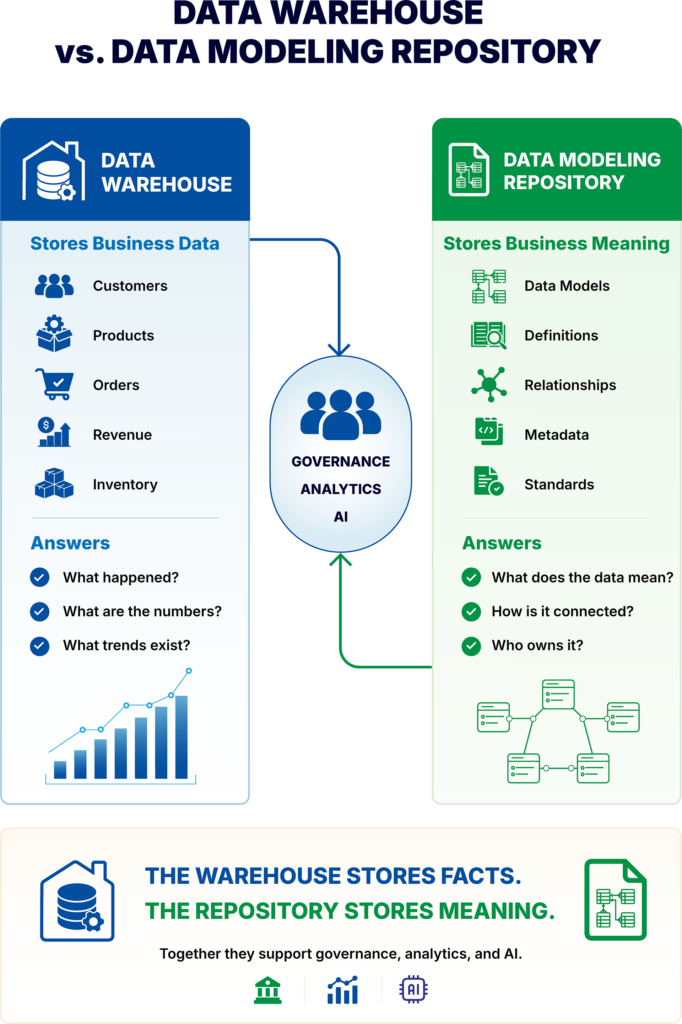
A data warehouse stores business data.
A data modeling repository stores the meaning, structure, relationships, and design of that data.
Understanding how these two systems work together can help organizations build stronger foundations for analytics, governance, modernization, and AI.
Most organizations are familiar with the role of a data warehouse.
A data warehouse consolidates data from multiple operational systems into a centralized environment designed for reporting, analytics, and decision-making.
A warehouse may contain:
The purpose of the warehouse is to help answer questions such as:
The warehouse contains the actual business data used to answer those questions.
It serves as the system of record for facts, metrics, and historical information.
For most organizations, the warehouse represents one of the most valuable data assets in the enterprise.
A data modeling repository serves a different purpose.
Instead of storing customer records, orders, products, or transactions, it stores information about those assets.
For example, a repository may contain:
While the warehouse might contain millions of customer records, the repository contains information about what a customer is, how customers relate to other business concepts, which systems use customer data, and how that definition has evolved over time.
Think of it this way.
The warehouse stores the data.
The repository stores the understanding of the data.
That distinction becomes increasingly important as organizations grow more complex and data is distributed across multiple platforms and teams.
One of the simplest ways to understand the relationship between a repository and a warehouse is through an architectural analogy.
Imagine a commercial office building.
The building itself contains offices, meeting rooms, utilities, equipment, and people. It is the operational environment where business activities take place.
The architectural blueprints, however, serve a different purpose. They describe how the building is structured, how systems connect, and how future changes should be managed.
The warehouse is the building.
The repository is the blueprint.
Both are valuable.
Neither replaces the other.
The warehouse helps the business operate.
The repository helps the business understand and manage the structure behind that operation.
The relationship between a repository and a warehouse is not theoretical. In many organizations, they actively exchange information throughout the lifecycle of a data platform.
Sometimes the repository drives the warehouse.
Other times the warehouse informs the repository.
The most mature organizations establish a continuous relationship between the two.
In many projects, the process begins inside the repository.
Data architects create logical data models that describe business concepts such as customers, products, orders, contracts, claims, accounts, or suppliers. These logical models help stakeholders validate requirements and establish a common understanding of how information should be organized.
Once the logical design has been approved, it can be transformed into a physical data model that includes platform-specific implementation details such as datatypes, keys, constraints, and database structures.
From there, SQL or DDL scripts can be generated and used to create the actual warehouse structures.
In this scenario, the repository serves as the blueprint that drives implementation.
The flow looks something like this:
Business Requirements → Logical Model → Physical Model → Database Code → Data Warehouse
This process helps ensure that business meaning is established before technical implementation begins.
Not every organization starts with formal models.
Many companies already have warehouses that have evolved over years or even decades. In these environments, documentation is often incomplete, outdated, or entirely missing.
This is where reverse engineering becomes valuable.
Modern data modeling platforms such as ER/Studio can connect directly to warehouse platforms and read their structures.
Rather than importing the data itself, the modeling platform reads metadata such as:
That metadata is then used to generate models inside the repository.
In this case, the warehouse becomes the source and the repository becomes the destination.
Organizations gain visibility into environments that may have existed for years without proper documentation.
One of the most valuable aspects of a repository is its ability to help organizations manage change.
Consider a scenario where the business decides to introduce customer segmentation.
The warehouse currently contains customer information, but no segmentation attribute.
Architects update the logical and physical models within the repository. The repository now reflects the desired future state of the environment.
Using model comparison capabilities, the repository can identify differences between the approved design and the deployed warehouse.
This process helps answer questions such as:
Without a repository, these changes are often managed manually through spreadsheets, meetings, and tribal knowledge.
With a repository, the design becomes a governed asset that can be compared, tracked, and managed over time.
As organizations invest in data governance initiatives, repositories become increasingly valuable.
Governance programs depend on clear definitions, ownership, standards, and relationships. While warehouses contain the data itself, they often do not contain the broader business context needed for governance.
For example, a warehouse table may contain a field called:
CUSTOMER_STATUS
The warehouse stores the values.
The repository helps answer questions such as:
This additional context helps bridge the gap between technical implementation and business understanding.
As governance programs mature, repositories often become an important source of trusted metadata.
The relationship between repositories and warehouses is becoming even more important in the age of AI.
Large language models and AI assistants are increasingly expected to reason across multiple systems, datasets, reports, and business domains. While warehouses provide access to facts and transactions, they do not always provide sufficient context for understanding what those facts mean.
Consider a warehouse containing fields such as:
The data exists.
The meaning may not.
A repository can provide definitions, relationships, business rules, hierarchies, and semantic context that help AI systems interpret information more accurately.
This is one reason enterprise logical data models are receiving renewed attention. As organizations move toward AI-driven architectures, preserving business meaning becomes just as important as storing business data.
The warehouse provides the facts.
The repository helps explain those facts.
Together they create a stronger foundation for trustworthy analytics and AI.
Increasingly, organizations are viewing the repository as more than a modeling tool.
It becomes a semantic backbone that connects architecture, governance, metadata, analytics, and AI initiatives.
Within the repository, teams can establish shared business concepts that remain consistent across systems, projects, and technologies.
Those concepts can then support:
Rather than allowing meaning to fragment across applications and departments, the repository provides a centralized place where enterprise business understanding can be managed and governed.
This role is becoming increasingly important as organizations attempt to scale AI responsibly.
The discussion should not be framed as a choice between a repository and a warehouse.
The strongest organizations use both.
The warehouse stores business data and supports operational analytics.
The repository stores business meaning and supports architectural consistency.
The warehouse answers questions about what happened.
The repository answers questions about what the data means.
Together they create a more complete foundation for governance, modernization, analytics, and AI.
Organizations that invest in both capabilities are often better positioned to manage complexity, reduce ambiguity, and maintain consistency as their data environments continue to evolve.
ER/Studio helps organizations create and manage the repository layer that connects business meaning to technical implementation. Through logical and physical data modeling, reverse engineering, model comparison, metadata management, and enterprise architecture capabilities, ER/Studio provides a centralized repository for understanding and governing enterprise data.
As data environments become larger, more distributed, and increasingly AI-driven, maintaining a trusted understanding of business concepts becomes just as important as storing the data itself.
The warehouse may contain the facts, but ER/Studio helps organizations preserve the meaning behind those facts.
Discover how a centralized data modeling repository can strengthen governance, analytics, and AI initiatives. Try ER/Studio free today.
A data modeling repository is a centralized location for storing and managing data models, business definitions, metadata, relationships, naming standards, and other architectural information. Unlike a data warehouse, it does not store business transactions or records. Instead, it stores information about the structure and meaning of enterprise data.
A data warehouse stores business data used for reporting, analytics, and decision-making. A data modeling repository stores metadata, data models, business definitions, and relationships that help organizations understand and govern that data. In simple terms, the warehouse stores the facts, while the repository stores the meaning behind those facts.
Yes. Modern data modeling platforms like ER/Studio can connect directly to data warehouses and databases to reverse engineer schemas, compare models to deployed systems, identify differences, and synchronize architectural designs with implementation environments.
Data governance depends on consistent definitions, standards, ownership, and business rules. A data modeling repository helps organizations document and manage this information in a centralized location, creating a trusted source of metadata that supports governance, compliance, and collaboration across teams.
AI systems can access large amounts of data, but they often lack the business context needed to interpret that data accurately. A data modeling repository provides definitions, relationships, business rules, and semantic context that help improve the accuracy, consistency, and trustworthiness of AI-generated insights.