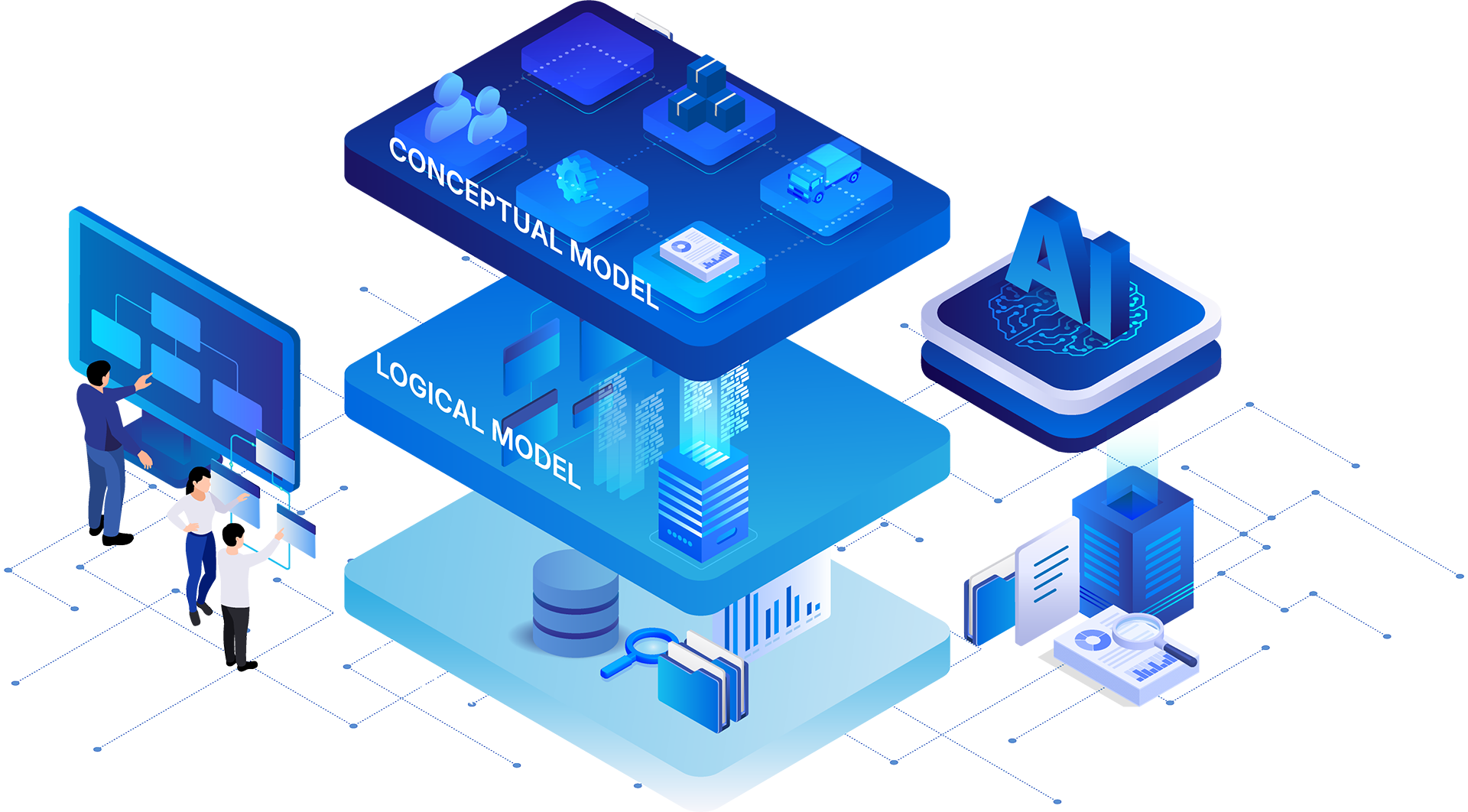
Learn the differences between conceptual, logical, and physical data models and why logical modeling creates the semantic foundation for trusted AI.
Artificial intelligence has dramatically changed how organizations build software and databases. Ask an AI assistant to design a database for inventory management, employee records, or order processing, and within seconds it can generate SQL scripts, create tables, define columns, and recommend indexes. What once took hours of manual effort can now be completed in moments.
This speed has led some to wonder whether traditional data modeling is becoming less important. If AI can generate a database from a simple prompt, do organizations still need conceptual and logical data models?
The answer is yes, and perhaps now more than ever.
What AI generates is typically a physical implementation. It creates database objects designed for a specific platform, but it cannot determine how your business defines its most important concepts, how those concepts relate to one another, or where inconsistencies exist across departments. Those decisions require human expertise, collaboration, and agreement long before the first table is created.
That work happens in the logical data model.
Understanding the difference between conceptual, logical, and physical data models has always been important for designing high-quality databases. As AI becomes a larger part of software development and analytics, understanding those differences has become essential for building trustworthy AI systems.
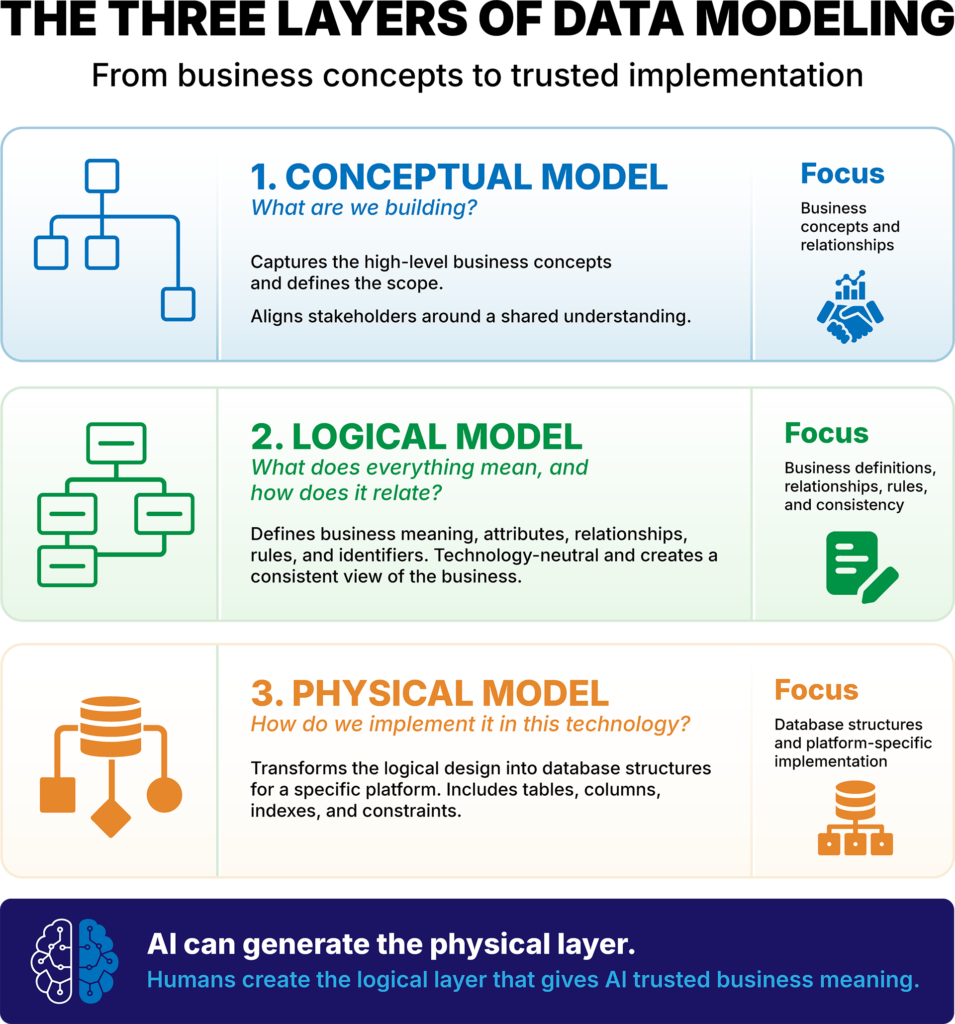
Although they are often discussed together, conceptual, logical, and physical data models serve very different purposes. Each answers a different question during the design process.
| Model Type | Primary Question | Primary Audience | Focus |
| Conceptual | What business concepts exist? | Business stakeholders, executives | Business scope and terminology |
| Logical | How are those concepts defined and related? | Data architects, business experts | Business meaning, relationships, rules |
| Physical | How will this be implemented? | Database developers, engineers | Database structures, SQL, performance |
Rather than replacing one another, these models build upon each other.
The conceptual model establishes a shared understanding of the business domain. The logical model transforms those concepts into detailed business structures and relationships. The physical model converts those designs into technology-specific implementations.
Each layer adds precision, but only one captures the business meaning that AI systems ultimately depend on.
A conceptual data model represents the business at the highest level.
Rather than focusing on database tables or implementation details, it identifies the major concepts that exist within an organization and how they relate to one another. These models help business leaders, subject matter experts, and architects agree on the overall scope of a solution before detailed design begins.
For example, an organization developing an enterprise asset management platform might identify concepts such as:
At this stage, the discussion is intentionally simple.
Everyone agrees that these concepts exist, but the model does not yet define attributes, keys, or detailed business rules. The goal is alignment, not implementation.
Conceptual models establish a common language that allows business and technical teams to begin working from the same understanding.
Once the business concepts have been identified, the logical data model begins answering much deeper questions.
What exactly is an asset?
How should assets relate to facilities?
Can an asset belong to multiple locations over time?
How are inspections connected to maintenance activities?
Which identifiers uniquely distinguish one asset from another?
These questions cannot be answered by a database platform or an AI assistant. They require collaboration between architects and business experts who understand how the organization actually operates.
This is where the logical model becomes the semantic foundation of the enterprise.
Unlike physical models, logical models are independent of any specific database technology. Instead, they define the meaning of business entities, their relationships, cardinality, business rules, and shared terminology.
This layer captures institutional knowledge that often exists only in the minds of experienced employees.
When organizations invest time in logical modeling, they are not simply preparing to generate databases. They are documenting how the business understands its own information.
That understanding becomes increasingly valuable as organizations expand governance, analytics, and AI initiatives.
The physical data model translates logical designs into database-specific implementations.
This is where architects and developers define:
A physical model designed for Microsoft SQL Server will differ from one designed for Snowflake, PostgreSQL, Oracle, or Databricks because every platform has unique capabilities and optimization techniques.
This is also the layer where AI assistants excel.
Modern large language models can generate SQL remarkably well. They understand database syntax, common naming conventions, normalization patterns, and many platform-specific features.
If you ask an AI assistant to build an asset management database, it can quickly produce tables such as Asset, Maintenance, Facility, Inspection, and Employee.
The resulting schema may even appear professional.
The challenge is that the AI is making assumptions.
Those assumptions may or may not reflect how your business actually defines those concepts.
Imagine asking an AI assistant to generate a database for enterprise asset management.
Within seconds, it produces tables named Asset, MaintenanceRecord, Facility, Inspection, and Vendor.
It assigns columns.
It creates relationships.
It generates foreign keys.
It even recommends indexes.
From a technical perspective, the output looks impressive.
But where did the definitions come from?
How did the AI determine what qualifies as an asset?
Did it know whether leased equipment should be treated differently from owned equipment?
Did it understand whether software licenses, vehicles, manufacturing equipment, and buildings are all considered assets within your organization?
Did it know how Operations defines an asset compared to Finance or Maintenance?
The answer is no.
The AI generated a physical schema based on patterns learned from public examples and probability. It did not consult your organization’s business definitions because it has no inherent knowledge of them.
Those definitions belong in the logical data model.
Consider a manufacturing organization.
Operations defines an “asset” as any piece of equipment used during production.
The maintenance department defines an asset as equipment requiring scheduled service.
Finance considers an asset something that appears on the balance sheet and depreciates over time.
Meanwhile, IoT systems identify assets as telemetry sources that continuously generate operational data.
All four perspectives are valid.
They simply represent different views of the same business concept.
If an AI assistant generates a database without understanding those distinctions, it will likely create a single generic Asset table.
That may satisfy the technical requirement of producing SQL, but it fails to capture the business meaning needed across the enterprise.
A logical data model resolves these differences before implementation begins.
Architects work with stakeholders to establish common definitions, identify relationships, document business rules, and determine how each perspective connects within a unified enterprise view.
Once that shared understanding exists, generating the physical implementation becomes far more straightforward.
More importantly, every downstream system inherits the same business meaning.
That consistency becomes invaluable when organizations begin feeding enterprise data into AI systems.
Large language models do not reason about enterprise data the way people do.
They recognize statistical patterns.
Without additional business context, they cannot reliably distinguish between concepts that appear similar but have very different meanings inside an organization.
That is why enterprise AI increasingly depends on semantic consistency.
When logical models define business entities, relationships, identifiers, and terminology, they provide the context AI systems need to interpret information correctly.
Instead of relying on disconnected schemas or isolated datasets, AI can operate from a governed understanding of enterprise meaning.
This reduces semantic entropy, where definitions gradually diverge across applications, analytics platforms, governance tools, and AI environments.
The logical model becomes much more than documentation.
It becomes a trusted semantic asset.
One misconception about logical modeling is that it introduces unnecessary work before implementation.
In reality, modern data modeling platforms eliminate much of that effort.
Rather than forcing architects to recreate the same design multiple times, solutions like ER/Studio allow teams to design at the logical level first and automatically generate physical models for multiple database platforms.
As business requirements evolve, logical models remain the authoritative source.
Physical implementations can then be regenerated or synchronized without losing the underlying business definitions that drive the design.
This approach offers several important advantages.
Organizations can:
Instead of choosing between business alignment and development speed, organizations gain both.
The rise of AI has changed how software is built, but it has not changed the importance of understanding enterprise data.
If anything, it has increased it.
AI can generate SQL.
It can recommend indexes.
It can optimize physical database structures.
What it cannot do is determine how your organization defines an asset, when two business concepts should remain separate, or how enterprise terminology should evolve over time.
Those decisions require collaboration between people who understand the business.
They belong in the logical data model.
As organizations invest in AI, analytics, governance, and modern data platforms, the logical layer is becoming the foundation that connects them all. It establishes the shared meaning that allows databases, governance platforms, semantic layers, analytics tools, and AI systems to operate from the same understanding of enterprise information.
The future of data architecture is not about choosing between AI and data modeling.
It is about combining AI’s ability to accelerate implementation with the human expertise required to define enterprise meaning.
That is precisely where the logical data model continues to deliver its greatest value.
For decades, many organizations viewed logical data models primarily as design artifacts. They helped architects communicate with stakeholders, guided database development, and documented how systems should be built.
That role has expanded significantly.
Today, Enterprise Logical Data Models (ELDMs) are becoming part of the infrastructure that supports AI.
Why? Because AI systems need more than access to data. They need access to meaning.
A sales report can tell an AI that revenue increased by 12 percent. A warehouse database can provide inventory levels. A maintenance system can report equipment failures.
None of those systems, however, explain what the business actually means by terms like “critical asset,” “planned maintenance,” “production downtime,” or “operational efficiency.”
Those definitions exist outside the data itself.
An Enterprise Logical Data Model captures that context by documenting business entities, relationships, business rules, and terminology in a structured, governed way. Instead of forcing AI to infer meaning from isolated tables, organizations can provide a semantic foundation that reflects how the business actually operates.
This distinction becomes increasingly important as AI moves beyond simple chatbots and begins supporting strategic decision-making, autonomous workflows, and enterprise-wide analytics.
Moving directly from a business idea to a physical database may seem like an efficient shortcut, especially when AI can generate implementation code in seconds.
In reality, that shortcut often introduces technical debt before development even begins.
Without a logical model, different teams frequently create their own interpretations of the same business concepts.
An analytics team may define an asset one way.
The maintenance application may define it differently.
A reporting team may simplify the concept for dashboards.
An AI application may rely on whichever definition happens to appear in the dataset it receives.
Over time, these inconsistencies spread throughout the organization.
Business glossaries become disconnected from implementation.
Governance catalogs describe concepts differently than operational systems.
Reports begin producing conflicting metrics.
AI assistants provide inconsistent answers because they are grounded in inconsistent data.
This gradual divergence is what many organizations experience as semantic entropy.
The challenge is rarely caused by poor technology.
It is usually caused by the absence of a single, authoritative source of business meaning.
The logical data model provides that source.
Rather than allowing every downstream system to define concepts independently, it establishes common definitions that analytics platforms, governance tools, semantic layers, and AI applications can all inherit.
One of the biggest advantages of modern data architecture is that organizations no longer need to treat logical and physical models as separate projects.
With ER/Studio, architects can begin with a governed Enterprise Logical Data Model that captures business meaning, relationships, and rules. That model then becomes the foundation for generating physical implementations across multiple database platforms.
Instead of rebuilding the same design for SQL Server, Snowflake, PostgreSQL, Oracle, or Databricks, teams can automate much of the translation while maintaining alignment with the original business design.
This approach delivers several important benefits.
As organizations modernize their data platforms, this “design once, reuse everywhere” approach becomes increasingly valuable. It reduces duplication, improves collaboration, and helps ensure that enterprise meaning is preserved as data moves between systems.
AI can accelerate database development, but it cannot replace the collaborative work required to establish enterprise meaning.
ER/Studio helps organizations bridge that gap by supporting every stage of the modeling process.
Architects can capture high-level business concepts in conceptual models, refine those concepts into detailed Enterprise Logical Data Models, and automatically generate physical models for the technologies that power modern data platforms.
Beyond modeling, ER/Studio connects architecture with governance by supporting business glossaries, metadata management, lineage, collaboration, and integrations with platforms such as Microsoft Purview and Collibra. The result is a connected architecture where business meaning is established once and carried consistently from design through implementation.
As organizations expand AI initiatives, that consistency becomes a strategic advantage.
Instead of asking AI to interpret disconnected schemas and conflicting terminology, organizations can ground AI in governed enterprise knowledge that reflects how the business actually understands its data.
That is the difference between generating databases and building AI-ready data architectures.
The growing popularity of AI coding assistants has understandably shifted attention toward automation.
Generating SQL has become easier.
Building physical schemas has become faster.
Implementing databases has become more efficient.
None of those advances reduce the importance of defining what enterprise data actually means.
In fact, they make it even more important.
As AI accelerates implementation, organizations need a stronger semantic foundation to ensure that what is being built accurately reflects the business. The logical data model provides that foundation by documenting shared definitions, relationships, and business rules before implementation begins.
Conceptual models establish the scope.
Logical models establish the meaning.
Physical models implement the solution.
Each layer has an important role, but the logical layer is where enterprise knowledge becomes structured, reusable, and ready to support governance, analytics, and AI.
The organizations that achieve the greatest success with AI will not simply generate better code. They will build better understanding.
That understanding begins with the logical data model.
Discover how Enterprise Logical Data Models create the semantic foundation for trusted AI, modern data platforms, and enterprise governance. Try it free today.
A conceptual data model identifies high-level business concepts and defines the scope of a project. A logical data model adds business rules, relationships, attributes, and definitions without being tied to a specific database platform. A physical data model translates that design into database-specific tables, columns, indexes, and constraints.
AI systems depend on consistent business definitions and relationships to interpret enterprise data accurately. Logical data models provide the semantic context that helps reduce ambiguity, improve governance, and create more trustworthy AI outputs.
AI can assist with drafting a logical model, but it cannot determine an organization’s unique business definitions, terminology, or rules without human guidance. Creating those shared definitions requires collaboration between business stakeholders and data architects.
ER/Studio enables organizations to create conceptual, logical, and physical data models within a connected environment. Architects can design business-focused logical models and automatically generate synchronized physical models for multiple database platforms while maintaining consistency across the data lifecycle.
Starting with a logical model ensures that business meaning, relationships, and rules are agreed upon before implementation begins. This reduces rework, improves governance, creates more consistent databases, and provides a stronger semantic foundation for analytics and AI.