The term “data management software” means different things to different buyers.
Vendors apply it to everything from database design tools to compliance platforms. For procurement teams researching replacements for systems like PowerDesigner, this category confusion creates real problems. Comparison charts end up stacking tools that solve fundamentally different challenges.
Enterprise data management splits into four categories that are not interchangeable: data modeling platforms, metadata catalogs, governance frameworks, and integration tools. Each serves a specific purpose. Most enterprises need several working together rather than one platform claiming to handle everything.
This breakdown covers what each category does, which tools lead in each space, and how they connect. Every product review follows the same structure: a brief overview, the key features that define it, and a quick-hit list of reasons to put it on the shortlist.
Before evaluating individual tools, it helps to understand what each category actually does. The table below maps each category to its core function and the tools that lead in that space.
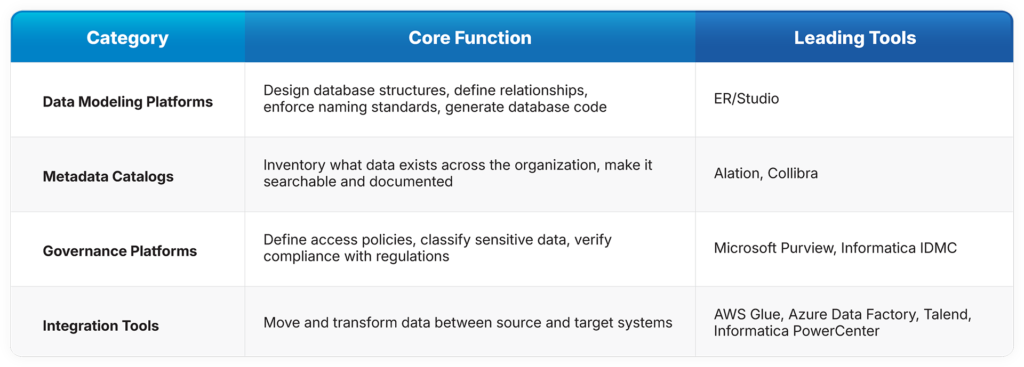
These categories overlap at the edges but are not substitutes for each other. A metadata catalog documents what exists; a modeling platform designs what should exist. A governance platform enforces policy; an integration tool moves the data. Getting the right combination matters more than finding a single platform.
Data modeling tools create the structural blueprint for how databases store and relate information. They design tables, define relationships, enforce naming standards, and generate database code. This is the foundation layer. Everything downstream, including catalogs, governance, and integration, depends on accurate structural metadata originating here.
Overview
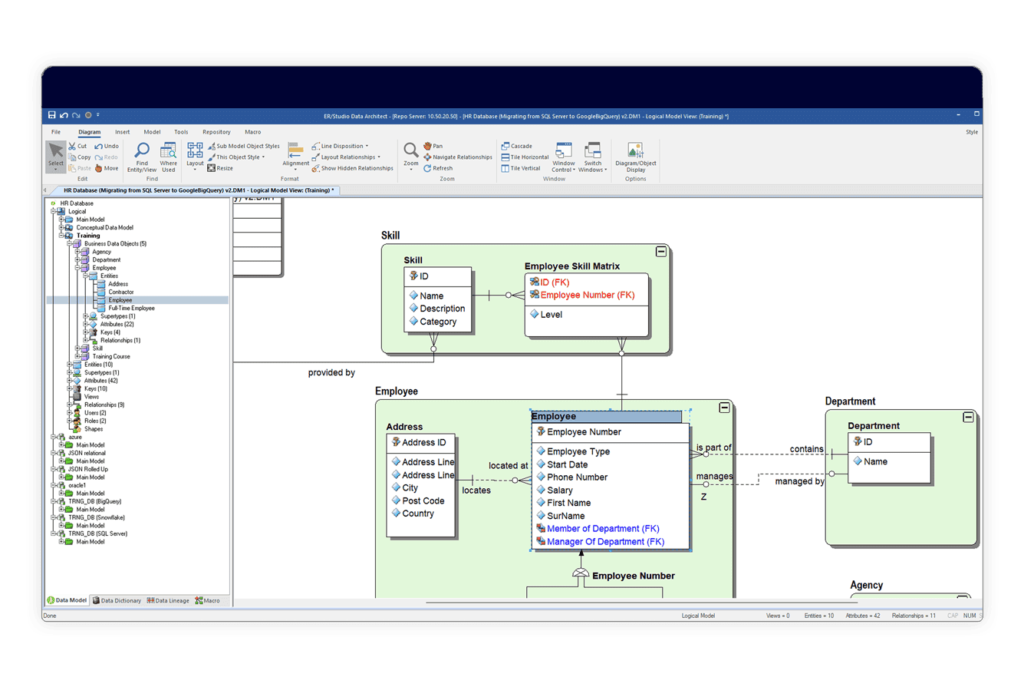
ER/Studio has been a fixture in enterprise data architecture for over two decades.
The platform handles conceptual, logical, and physical modeling layers and supports reverse and forward engineering across every major database platform, from legacy mainframe DB2 to Snowflake and Databricks. What sets ER/Studio apart from lighter modeling tools is how it treats governance not as an afterthought but as a native extension of the modeling workflow. Models built in ER/Studio function as the authoritative structural metadata source, publishing directly to governance systems through configured synchronization.
The Enterprise edition includes multi-user collaboration through centralized repositories with version control and conflict resolution. For teams with five architects or fifty developers spanning multiple time zones, the repository architecture handles concurrent access without the constant merge conflicts that plague file-based modeling approaches.
ER/Studio’s ERbert AI assistant accelerates documentation, surfaces modeling suggestions, and reduces manual effort on routine tasks. ERbert analyzes database metadata to document existing structures, identifies potential normalization improvements, and helps translate business requirements into technical models.
Key Features
Direct governance integration: Publishes structural metadata to Microsoft Purview and Collibra through native connectors rather than manual exports.
Full modeling lifecycle: Supports conceptual, logical, and physical layers with transformation between them. Business stakeholders can review conceptual models while DBAs work at the physical level, all within the same platform.
Broad platform coverage: Reverse and forward engineering across all major database platforms. Mainframe DB2 alongside Snowflake, Oracle next to cloud PostgreSQL, without gaps that force workarounds.
Enterprise collaboration: Centralized repository with granular locking, version control, conflict resolution, and full audit trails.
Impact analysis: Traces dependencies across models before changes go live, identifying affected downstream systems.
Data Mesh support: Domain teams model their data products independently while the platform federates those models into an enterprise view for compliance reporting.
Why Consider ER/Studio
Overview
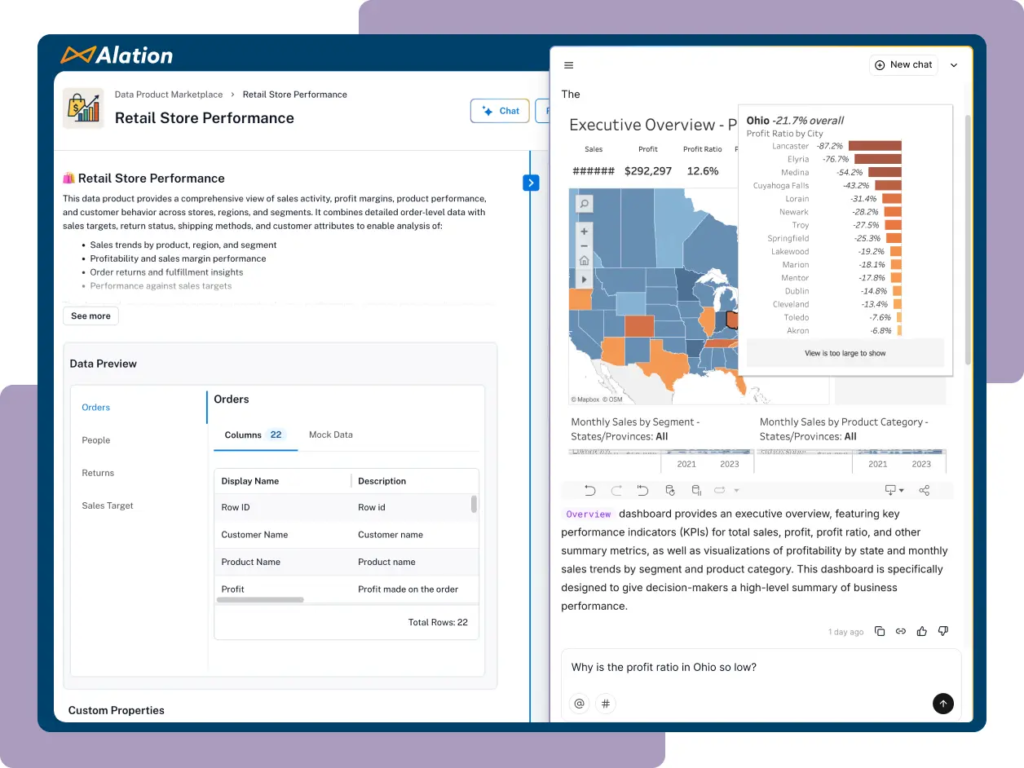
Alation pioneered the “data catalog as search engine” approach, and it shows in how the platform handles day-to-day data discovery. Rather than relying on top-down governance mandates to populate metadata, Alation leans into crowdsourced tagging and usage analytics. Analysts and data engineers tag assets, add definitions, and document tribal knowledge directly in the tool. Over time, the catalog becomes a living knowledge base shaped by the people closest to the data.
The search experience feels familiar to anyone who has used Google internally. Type a question, and Alation surfaces the most relevant datasets, tables, and columns based on both metadata and actual query patterns across the organization.
Key Features
Behavioral intelligence: Tracks how data assets are actually queried and used across the organization, surfacing the most relevant results based on real usage patterns.
Crowdsourced curation: Any authorized user can contribute definitions, flag issues, or add context to data assets, building institutional knowledge organically.
Search-first UX: Natural language search with auto-suggestions, filters, and relevance ranking tuned to data discovery.
Why Consider Alation
Overview
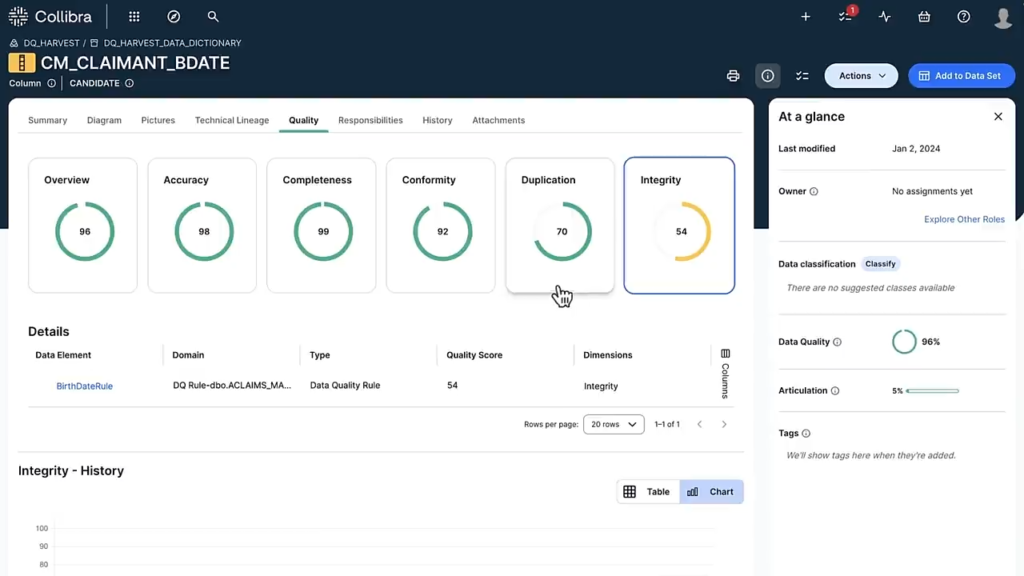
Collibra takes a more structured approach to data cataloging than its search-driven peers. The platform centers on formal governance workflows: data steward assignments, policy enforcement, certification processes, and audit trails. In regulated industries like financial services, healthcare, and insurance, where accountability matters as much as discovery, Collibra’s workflow-driven design is a natural fit.
Collibra’s business glossary management gives organizations a single, authoritative place to define terms. When different divisions define “customer” differently, Collibra’s governance workflows reconcile those definitions and assign ownership. The platform also includes data quality monitoring, though that often requires additional modules or integrations depending on the deployment.
Key Features
Stewardship workflows: Assigns ownership to data assets with defined certification, review, and approval processes.
Business glossary: Central repository for business term definitions with governance around who can create, modify, and approve terms.
Audit trails: Full traceability of who changed what, when, and why, supporting regulatory compliance requirements.
ER/Studio integration: Structural metadata from ER/Studio models publishes directly into Collibra’s catalog, keeping governance systems synchronized with architectural changes.
Why Consider Collibra

Overview
Microsoft Purview delivers cloud-native governance tightly integrated with the Azure ecosystem. The platform scans data sources automatically, classifies sensitive information using built-in and custom sensitivity labels, and tracks access patterns across Azure Data Lake, Synapse, SQL Server, and an expanding set of multi-cloud connectors.
For organizations already invested in the Microsoft stack, Purview’s integration depth is hard to match. Data classification, lineage tracking, and policy enforcement all happen within the same administrative surface that IT teams already use for Azure resource management. That operational familiarity reduces adoption friction significantly.
Purview’s integration with ER/Studio means structural metadata from data models flows directly into the governance layer. When an architect adds or modifies a table in ER/Studio, that change propagates to Purview through configured workflows rather than a manual re-scan.
Key Features
Automated data discovery and classification: Scans connected sources on schedule, applying sensitivity labels to personally identifiable information, financial data, and custom categories.
Data lineage: Visual lineage maps showing how data flows from source systems through transformations to reporting layers.
Azure-native administration: Managed through the Azure portal, inheriting existing role-based access controls and identity management.
Expanding multi-cloud support: Connectors for AWS S3, Google BigQuery, and other non-Microsoft sources continue to grow in breadth.
Why Consider Microsoft Purview
Overview
The Informatica Intelligent Data Management Cloud (IDMC) brings enterprise-grade governance to organizations running across hybrid and multi-cloud environments. Where Purview excels in Azure-native scenarios, Informatica IDMC was built from the ground up to handle the messy reality of data sprawled across AWS, Azure, GCP, and on-premises infrastructure simultaneously.
The platform handles complex data quality rules, manages master data domains, and supports legacy system integration that pure cloud platforms often struggle with. For multinational organizations navigating overlapping privacy regulations across jurisdictions, IDMC’s comprehensive data privacy management helps untangle cross-border compliance requirements.
Key Features
Multi-cloud governance: Unified governance layer spanning AWS, Azure, GCP, and on-premises infrastructure without requiring separate tools per cloud.
Master data management: Defines and enforces golden records for core business entities like customers, products, and suppliers across systems.
Data quality rules engine: Complex validation, standardization, and enrichment rules applied at scale across heterogeneous data sources.
Multinational privacy compliance: Manages data residency, consent, and right-to-deletion requirements across overlapping jurisdictions.
Why Consider Informatica IDMC
Overview
Billed “the next generation of Amazon SageMaker,” AWS Glue is Amazon’s fully managed, serverless ETL service. It crawls data sources to build a metadata catalog, generates ETL code automatically, and executes jobs on a managed Apache Spark infrastructure. No servers to provision, no clusters to manage. For teams already operating within the AWS ecosystem, Glue integrates natively with S3, Redshift, RDS, and the broader AWS analytics stack.
The Glue Data Catalog doubles as a persistent metadata store compatible with Athena, EMR, and Redshift Spectrum, which reduces duplication of effort for teams running multiple AWS analytics services. Glue Studio provides a visual interface for building and monitoring ETL workflows, though more complex transformations typically still require writing PySpark or Scala.
Key Features
Serverless execution: Auto-scales compute resources based on job size. No infrastructure management overhead.
Built-in data catalog: Crawlers discover schema and partition information automatically, making datasets queryable across AWS services.
Native AWS integration: Tight coupling with S3, Redshift, Athena, Lake Formation, and IAM for seamless security and access management.
Why Consider AWS Glue
Overview
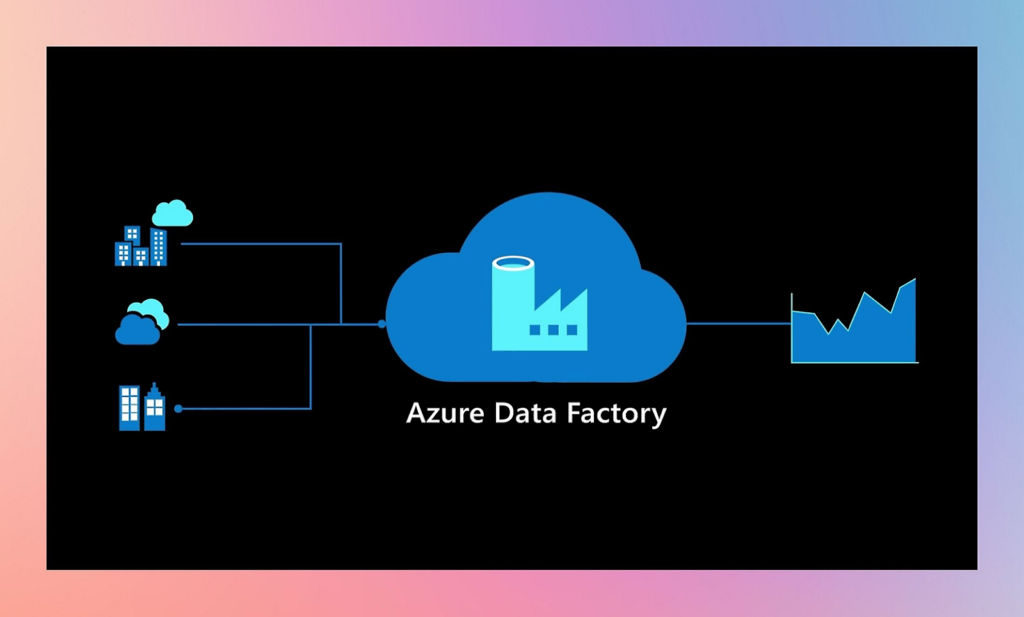
Azure Data Factory (ADF) is Microsoft’s cloud-native data integration service, designed to orchestrate data movement and transformation at scale across Azure and hybrid environments. ADF supports over 90 built-in connectors spanning cloud services, SaaS applications, and on-premises systems, making it a flexible option for organizations that have not fully migrated off legacy infrastructure.
The visual pipeline designer lets teams build complex data workflows through a drag-and-drop interface, while mapping data flows handle code-free transformations on a managed Spark backend. For teams that need to coordinate ETL with broader orchestration, ADF’s integration with Azure Synapse, Logic Apps, and Event Grid supports event-driven and scheduled pipeline patterns.
Key Features
90+ connectors: Pre-built connections to cloud, SaaS, and on-premises sources including SQL Server, SAP, Oracle, and Dynamics 365.
Mapping data flows: Visual, code-free transformation layer running on managed Spark clusters.
Hybrid integration runtime: Self-hosted integration runtime enables secure data movement from on-premises sources without exposing internal networks.
Why Consider Azure Data Factory
Overview
Talend grew out of the open-source ETL community and still carries that DNA in how the platform approaches integration design. The visual development studio (Talend Studio) generates native Java code from drag-and-drop job designs, which gives teams full control over the compiled output. That transparency matters for organizations with strict code review or audit requirements.
The connector library is extensive, covering everything from flat files and legacy RDBMS systems to modern cloud warehouses and streaming platforms. Talend Data Fabric bundles data integration with data quality, governance, and API management in a single platform, though most deployments start with the integration layer and expand from there.
Key Features
Native code generation: Visual designs compile to Java, giving full visibility into what the pipeline actually executes.
Extensive connector library: Hundreds of pre-built connectors spanning legacy, cloud, SaaS, and streaming sources.
Integrated data quality: Data profiling, cleansing, and standardization built into the integration pipeline rather than requiring a separate tool.
Why Consider Talend
Feature comparison charts miss the practical issues that derail implementations. The following criteria separate tools that work in production from tools that look good in demos.

Getting the modeling foundation right before layering governance on top is critical. Organizations that rush into governance platforms without documented data models end up with catalogs full of system-generated names nobody understands. The governance project stalls at month three.
Start by modeling the most critical data domains. Document the structures that support revenue-generating systems or fall under regulatory oversight. Use these models to populate the governance platform with meaningful metadata instead of raw technical schemas.
Train business stakeholders to read conceptual models so they can validate that technical implementations match their requirements. Business meaning and technical structure stay aligned as systems evolve.
Establish model sharing practices across teams. Different divisions probably model customer data slightly differently. Reconcile these variations into shared definitions stored in an enterprise data dictionary. Future projects reuse these standardized components instead of reinventing basic entities.
Enterprise data modeling is the foundation. Everything else depends on it. ER/Studio functions as the authoritative source for structural metadata that flows to governance platforms, data catalogs, and integration tools.
The platform’s direct integrations with Purview and Collibra reduce the manual handoffs that cause governance drift. When an architect adds a new table to a model, that metadata flows to the governance catalog through configured workflows. When a data steward adds a business definition in Collibra, architects see it directly in their modeling environment.
Modern architectures like Data Mesh distribute data ownership across domain teams. ER/Studio supports this pattern while maintaining centralized governance. Domain teams model their data products independently. The platform federates these models into an enterprise view for compliance reporting and impact analysis.
For enterprises evaluating data management software, the question is not “which single tool does everything?” The question is “which combination of specialized tools solves the specific challenges at hand?” Data modeling platforms like ER/Studio create structural precision. Catalogs like Alation and Collibra make data discoverable and governed. Purview and Informatica IDMC enforce compliance. Integration tools from AWS, Azure, Talend, and Informatica move data between systems.
Each category serves a purpose. Most enterprises need at least three of these working together. The modeling platform becomes the authoritative source that feeds everything else.
Request a quote to see how ER/Studio fits into the enterprise data management stack.
Enterprise data modeling is the foundation. Everything else depends on it. ER/Studio functions as the authoritative source for structural metadata that flows to governance platforms, data catalogs, and integration tools.
Its direct integrations with Purview and Collibra reduce the manual handoffs that cause governance drift. When an architect adds a new table to a model, that metadata flows to the governance catalog through configured workflows. When a data steward adds a business definition in Collibra, architects see it directly in their modeling environment.
This bidirectional flow matters even more in modern architectures like Data Mesh, where data ownership is distributed across domain teams. ER/Studio supports this pattern while maintaining centralized governance. Domain teams model their data products independently, and the platform federates these models into an enterprise view for compliance reporting and impact analysis.
For enterprises evaluating data management software, the question is not “which single tool does everything?” The question is “which combination of specialized tools solves the specific challenges at hand?”
Data modeling platforms like ER/Studio create structural precision. Catalogs like Alation and Collibra make data discoverable and governed. Purview and Informatica IDMC enforce compliance. Integration tools from AWS, Azure, Talend, and Informatica move data between systems.
Each category serves a purpose, and most enterprises need at least three of these working together. The modeling platform becomes the authoritative source that feeds everything else.
Every tool in your stack depends on the model. Get it right first.
Request a quote and see how ER/Studio fits.